Hydrogen Storage Technologies: Current Status, Challenges, and Future Prospects
Keywords:
Hydrogen Storage Technologies, Advanced Storage Materials, Techno-Economic Assessment, Renewable Energy Integration, Energy System DecarbonizationAbstract
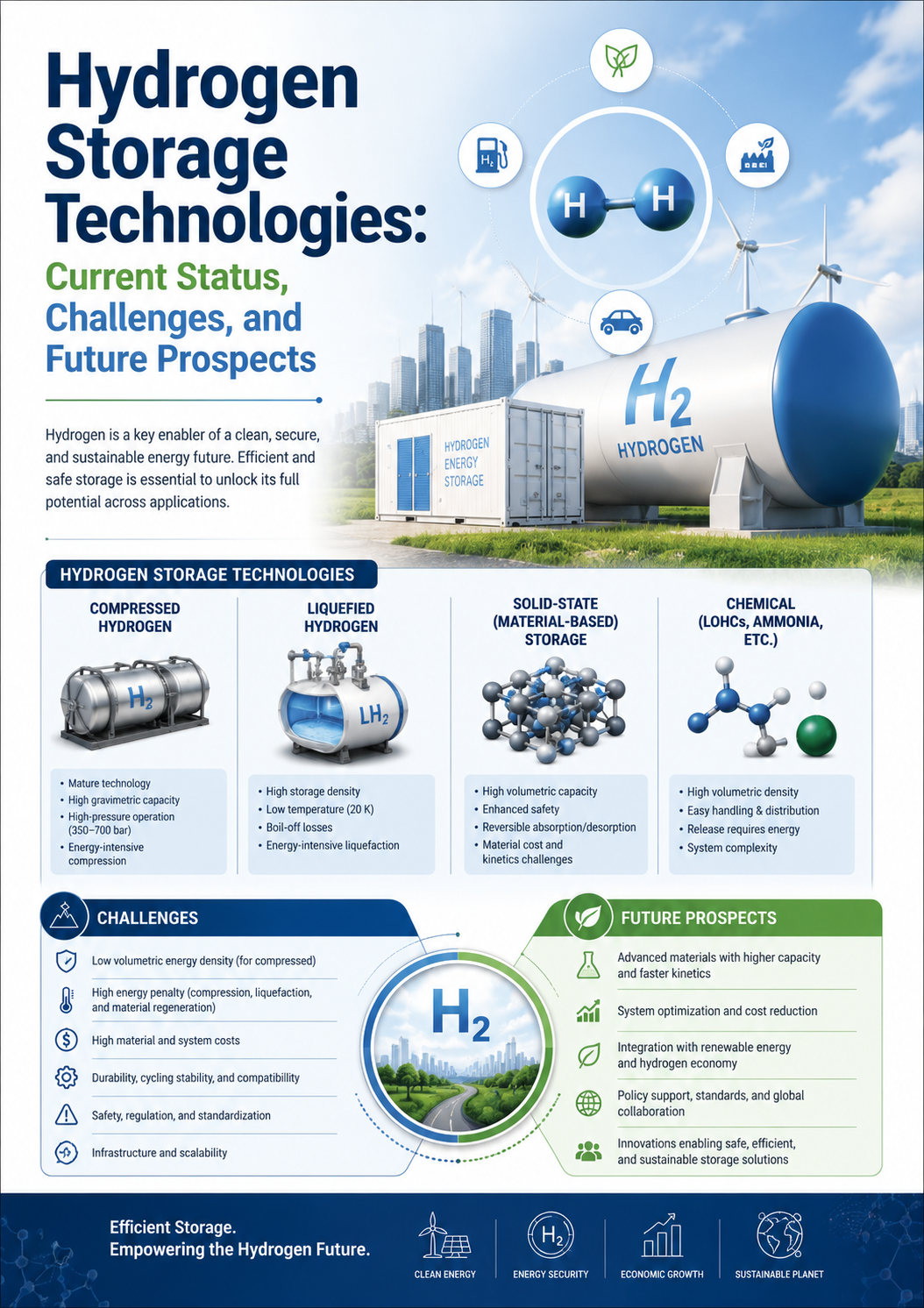
Hydrogen storage is a pivotal enabler of the emerging hydrogen economy, yet its large-scale deployment remains constrained by interconnected challenges spanning materials performance, safety governance, techno-economic viability, power-system integration, and sustainability alignment. This article presents an integrated assessment of hydrogen storage technologies, emphasizing that progress in advanced storage media, such as metal and complex hydrides, liquid organic hydrogen carriers, and nanostructured materials, can improve gravimetric and volumetric densities while reducing operating pressures and temperatures. However, limitations related to kinetics, reversibility, degradation, and scalability persist, requiring multidisciplinary research that links materials innovation with system-level engineering. The study further highlights that safe expansion of hydrogen storage depends on harmonized standards, robust risk-based design practices, and real-time monitoring to address hazards including leakage, embrittlement, boil-off losses, and ignition risks across compressed, liquefied, and solid-state systems. A techno-economic perspective indicates that storage costs and energy efficiency penalties remain decisive barriers to competitiveness, underscoring the need for economies of scale, manufacturing innovation, and strategic integration with renewable hydrogen production. From an energy systems viewpoint, hydrogen storage is positioned as a strategic flexibility resource for high-renewable power networks by enabling long-duration and seasonal storage and sector coupling, despite lower round-trip efficiency relative to batteries. Finally, lifecycle environmental performance and coherent policy frameworks, including subsidies, carbon pricing, and sustained research support, are identified as essential to ensure that hydrogen storage delivers credible decarbonization and sustainability outcomes. Collectively, the findings demonstrate that hydrogen storage must be advanced through coordinated technological innovation, safety regulation, cost-reduction pathways, integrated infrastructure planning, and sustainability-oriented governance to realize its role in resilient, low-carbon energy systems.
Published
How to Cite
Issue
Section
Copyright (c) 2026 Int. J. Electr. Eng. Sustain.

This work is licensed under a Creative Commons Attribution-NoDerivatives 4.0 International License.