Hybrid AI and Optimization Algorithms for Performance Enhancement of Grid-Connected Solar PV Systems
Keywords:
Hybrid Artificial Intelligence, Grid-Connected Solar PV Systems, Maximum Power Point Tracking (MPPT), Metaheuristic Optimization, Smart Grid Energy ManagementAbstract
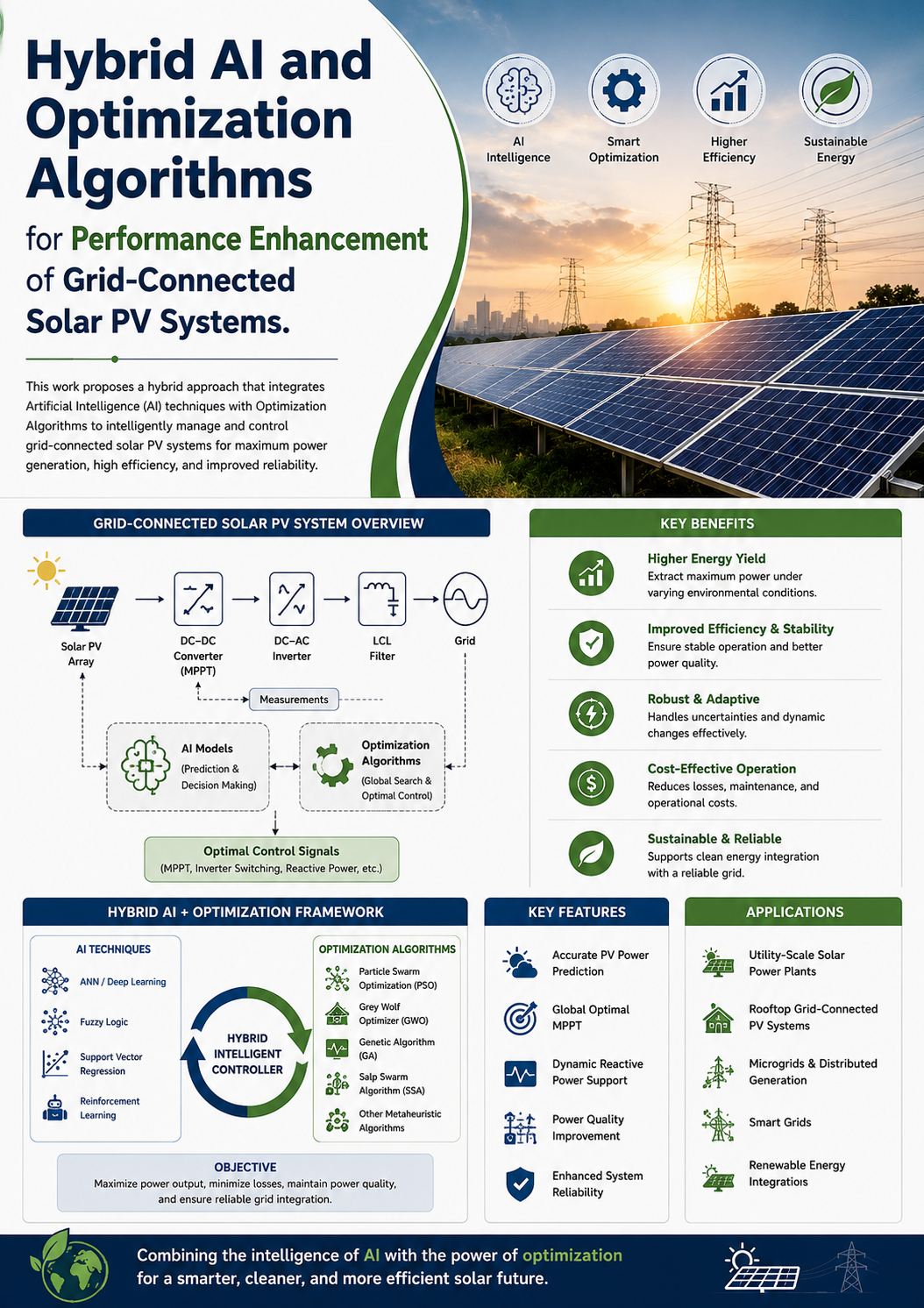
The increasing penetration of grid-connected solar photovoltaic (PV) systems has created significant challenges in maintaining efficiency, stability, and reliability under highly dynamic environmental conditions. Variations in solar irradiance, partial shading, temperature fluctuations, and load uncertainty degrade system performance and complicate control, forecasting, and energy management processes. In this context, hybrid artificial intelligence (AI) and optimization algorithms have emerged as a promising solution for enhancing PV system performance through intelligent, adaptive, and data-driven strategies. This study presents a comprehensive overview of hybrid AI and optimization techniques applied to key operational domains of PV systems. For Maximum Power Point Tracking (MPPT) under partial shading conditions, hybrid models such as ANN–PSO and CNN–GA are explored to improve tracking accuracy and convergence speed. In the area of real-time fault detection and predictive maintenance, deep learning frameworks using CNN and LSTM architectures enable early identification of degradation, hotspot formation, and inverter faults. Furthermore, hybrid metaheuristic optimization approaches such as PSO–GA and DE–ACO are examined for effective PV system parameter tuning, improving inverter efficiency and controller stability under varying irradiance conditions. Additionally, AI-based grid stability enhancement is addressed through reinforcement learning and adaptive control techniques aimed at mitigating voltage fluctuations, harmonics, and frequency deviations caused by PV intermittency. For energy forecasting and smart dispatch in PV-integrated smart grids, hybrid models such as LSTM–XGBoost and Transformer-based architectures are integrated to achieve accurate short-term solar power prediction and optimal energy scheduling. The findings highlight that hybrid AI and optimization frameworks significantly improve overall system efficiency, operational reliability, and smart grid performance, making them a key enabling technology for next-generation renewable energy systems.
Published
How to Cite
Issue
Section
Copyright (c) 2026 Int. J. Electr. Eng. Sustain.

This work is licensed under a Creative Commons Attribution-NoDerivatives 4.0 International License.