Artificial Intelligence–Driven Enhancement of Magnesium Alloys: A Comprehensive Review
Keywords:
Magnesium alloys, Artificial Intelligence, Machine Learning, Deep Learning, Materials Informatics, Microstructure, Corrosion Resistance, Mechanical PropertiesAbstract
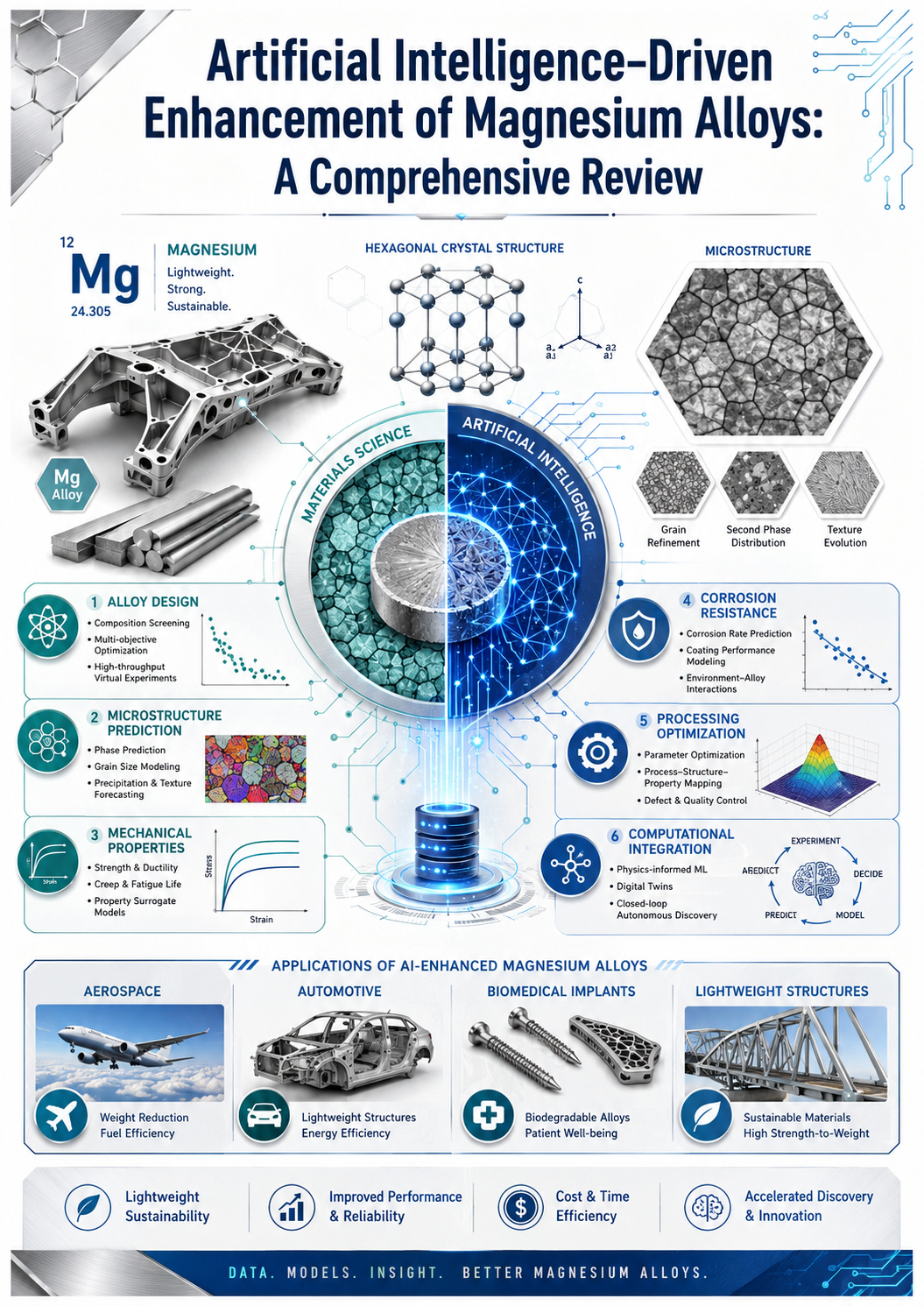
Magnesium alloys are the lightest structural metals in routine engineering use, at ~1.74 g/cm³, roughly one-third lighter than aluminium, yet their limited room-temperature ductility, susceptibility to corrosion in chloride environments, and inadequate creep resistance above ~120°C continue to restrict broader deployment. Addressing all three simultaneously through conventional alloy development, iterative synthesis and testing campaigns that can span years, is poorly matched to the pace demanded by modern manufacturing. Machine learning, deep learning, and nature-inspired optimization algorithms offer a principled alternative: map the composition-processing-property relationship from existing data, identify candidates computationally, and validate experimentally only where the model is confident. This systematic review analyzes 62 peer-reviewed studies published between 2018 and 2025, identified through a structured search of Scopus, Web of Science, ScienceDirect, and Google Scholar. AI applications examined span five domains: alloy composition design, microstructure prediction, mechanical property optimization, corrosion behavior modeling, and processing parameter control. Key findings indicate that ensemble methods (RF, XGBoost) dominate property prediction tasks on small datasets (R² = 0.88–0.96), while Bayesian Optimization leads in composition design efficiency. The integration of AI with CALPHAD, finite element analysis, and multiphysics simulation is critically assessed. Critical research gaps identified include the absence of standardized benchmark datasets, underutilization of uncertainty quantification, and limited closed-loop experimental validation. Future directions emphasize physics-informed neural networks, digital twins, and FAIR data principles as essential enablers for next-generation autonomous Mg alloy design.
Published
How to Cite
Issue
Section
Copyright (c) 2026 Int. J. Electr. Eng. Sustain.

This work is licensed under a Creative Commons Attribution-NoDerivatives 4.0 International License.