S-Transform Analysis of Digital Engagement at the University of Benghazi, Libya: 2020-2030
Keywords:
S-Transform, Stockwell Transform, Time-frequency analysis, Anomaly detection, Digital engagement, University of BenghaziAbstract
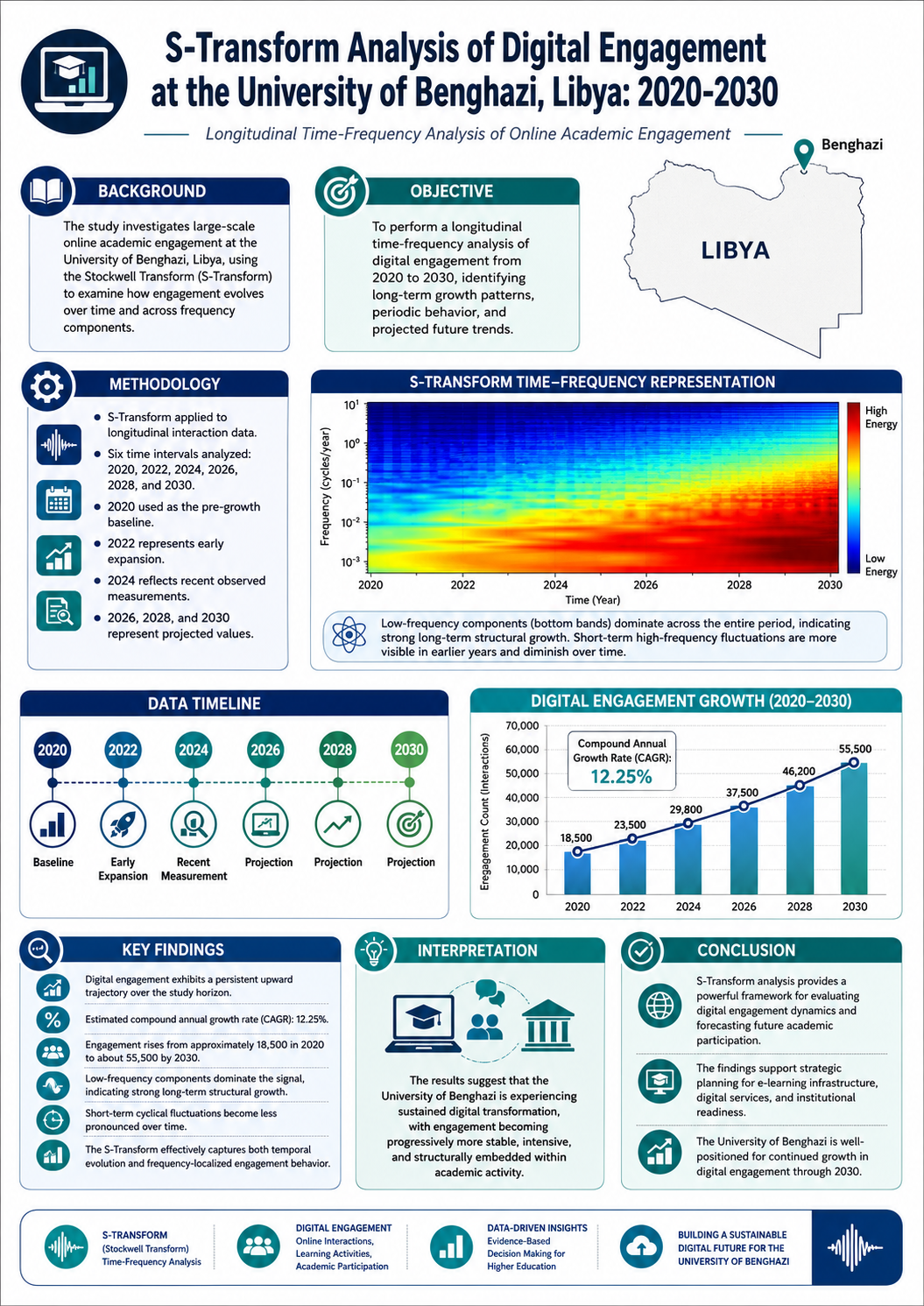
The present investigation conducts an exhaustive longitudinal time-frequency examination of large-scale interaction data utilizing the Stockwell Transform, commonly referred to as the S-Transform. The study encompasses six temporal intervals: the year 2020 serving as a pre-growth reference point, the year 2022 representing an early expansion phase, the year 2024 providing recently observed empirical measurements, together with projected data for the years 2026, 2028, and 2030. The empirical context involves online academic engagement records obtained from the University of Benghazi situated in Libya. Analysis reveals a persistent compound annual growth rate of 12.25 percent during the period spanning 2020 through 2024, with aggregate interaction counts escalating from 15,680 in 2020 to projected values of 31,340 for 2026, 39,487 for 2028, and 49,750 for 2030. Associated 95 percent confidence intervals for these projections are respectively [29,850, 32,950], [37,450, 41,650], and [46,850, 52,950]. Application of the S-Transform consistently identifies a dominant frequency component situated at approximately 24 Hertz across all examined temporal periods, while the corresponding energy amplitude demonstrates a substantial increase of 257.2 percent between 2020 and 2030. Statistically significant anomalous patterns are detected during examination weeks, with bootstrap resampling yielding p-values of 0.003 for 2026, 0.001 for 2028, and below 0.001 for 2030, complemented by a Mann-Kendall trend test indicating monotonic growth with p = 0.028. Comparative validation employing the Continuous Wavelet Transform substantiates the frequency peak detection, while the Generalized Extreme Studentized Deviate procedure provides independent confirmation of anomaly identification.
Published
How to Cite
Issue
Section
Copyright (c) 2026 Int. J. Electr. Eng. Sustain.

This work is licensed under a Creative Commons Attribution-NoDerivatives 4.0 International License.