Reducing Renewable Energy Curtailment in Solar–Wind Integrated Power Grids Using Uncertainty-Aware Multi-Agent Reinforcement Learning
Keywords:
Renewable Curtailment, Multi-Agent Reinforcement Learning, MAPPO, Conformal Prediction, Battery Storage, Demand Flexibility, Power-System OperationAbstract
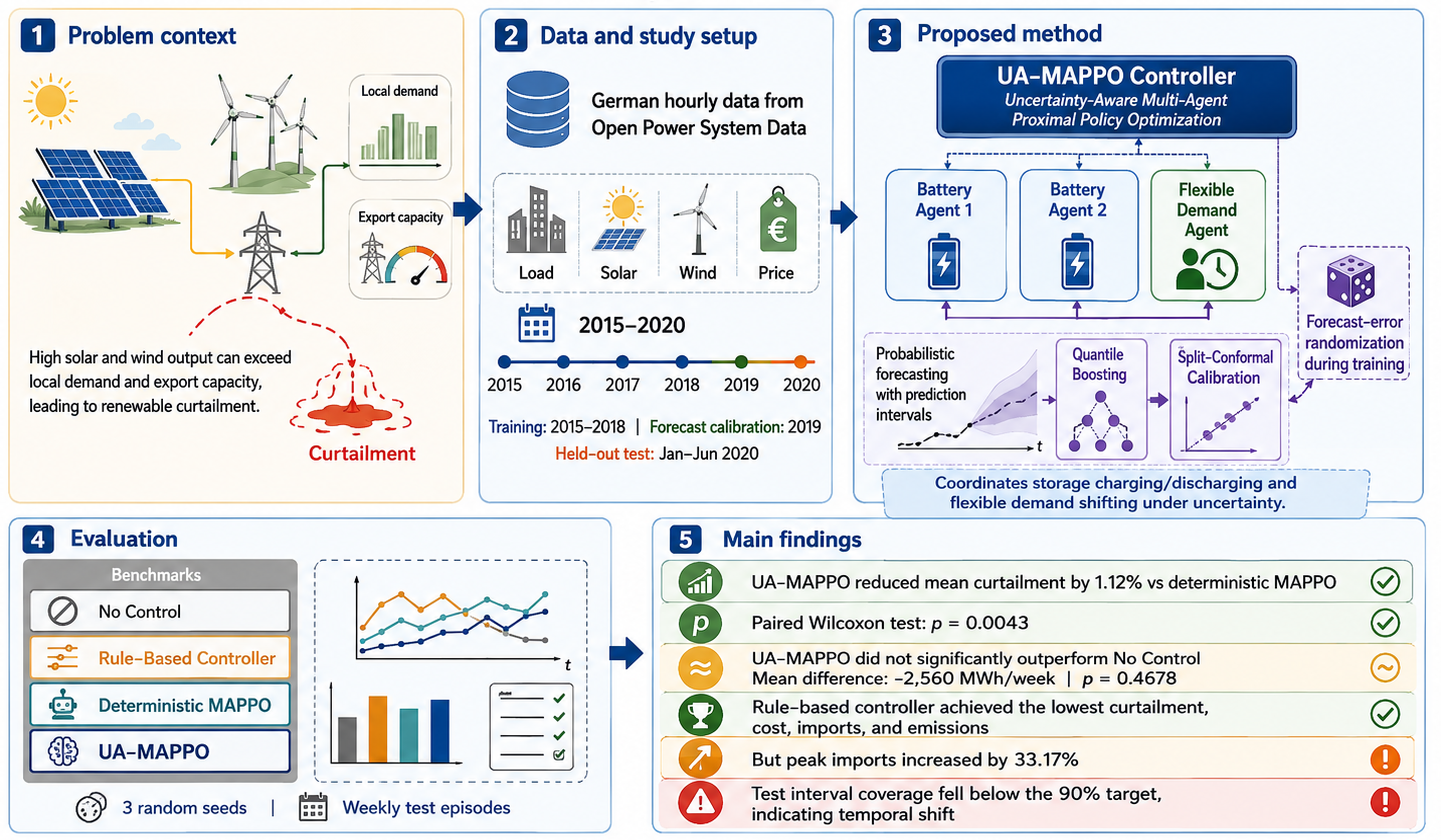
High levels of solar and wind generation may exceed local electricity demand and available export capacity, thereby necessitating renewable-energy curtailment. This study evaluates an uncertainty-aware Multi-Agent Proximal Policy Optimization framework for coordinating battery storage and flexible demand. The analysis uses hourly German load, solar generation, wind generation, and electricity-price data obtained from Open Power System Data for the period from January 2015 to June 2020. Data from 2015 to 2018 are used for model training, 2019 is reserved for forecast calibration, and the first half of 2020 is retained as a fully held-out test period. The proposed system comprises three agents controlling two battery-energy-storage units and one flexible-demand resource. Forecast uncertainty is represented through prediction intervals generated using quantile boosting and split-conformal calibration, while forecast errors are randomized during training to improve policy robustness. Learned policies are evaluated across three random seeds using weekly test episodes and compared with no-control, rule-based, and deterministic MAPPO benchmarks. The results show that UA-MAPPO reduced mean renewable-energy curtailment by 1.12% relative to deterministic MAPPO, with the paired Wilcoxon test indicating statistical significance at (p = 0.0043). However, UA-MAPPO did not significantly outperform the no-control benchmark, yielding a mean difference of −2,560 MWh per week with (p = 0.4678). The rule-based controller achieved the lowest curtailment, operating cost, imports, and emissions, although it increased peak imports by 33.17%. In addition, prediction-interval coverage during testing fell below the 90% target, indicating the presence of temporal distribution shift. Overall, the study therefore provides a transparent and reproducible benchmark, together with practical design insights for future research on intelligent renewable-energy management.
Published
How to Cite
Issue
Section
Copyright (c) 2026 Int. J. Electr. Eng. Sustain.

This work is licensed under a Creative Commons Attribution-NoDerivatives 4.0 International License.