Generative AI Adoption among University Students in Libya: Usage Patterns, Perceived Benefits, and Barriers
Keywords:
Generative Artificial Intelligence (GenAI), Elmergib University, Higher education, Students' perceptionsAbstract
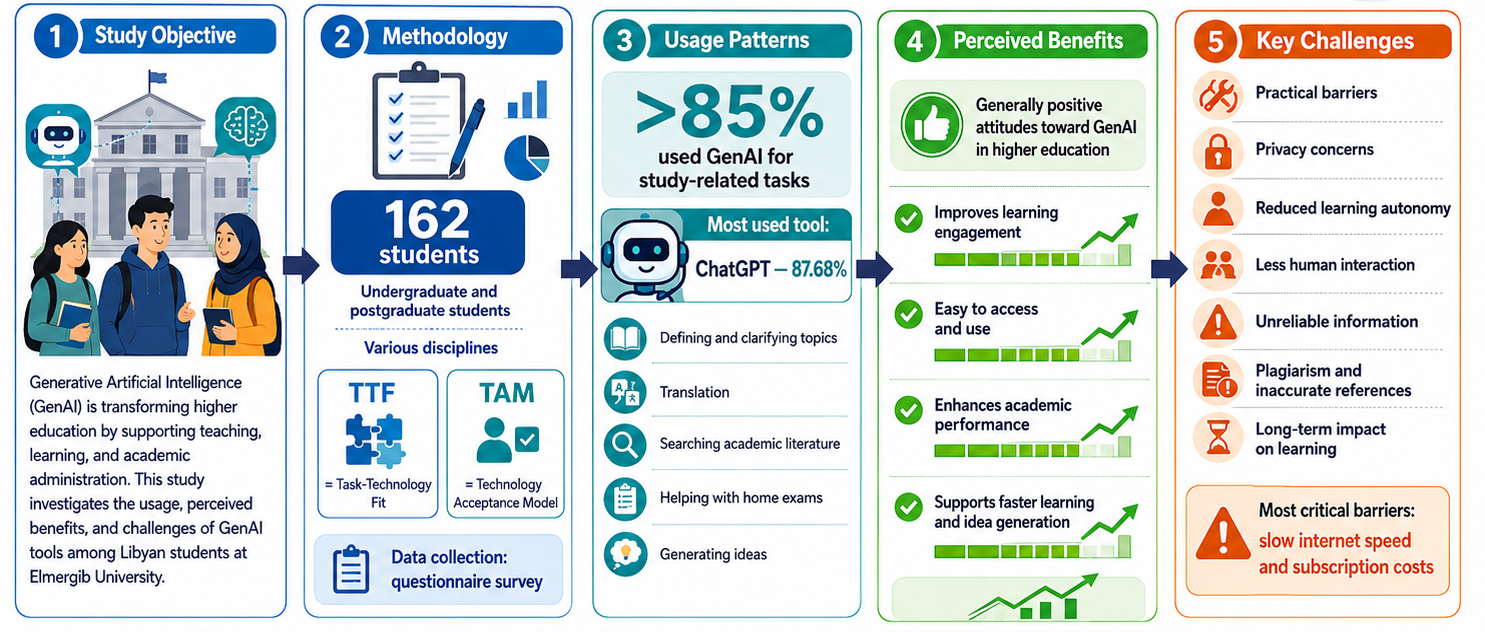
Generative Artificial Intelligence (GenAI) is transforming higher education around the world by providing opportunities to improve the entire teaching and learning process and institutional administration. The main objective of this study is to investigate the utilization, perceived benefits and challenges in using GenAI tools by Libyan students' at Elmergib University. The data were collected through a questionnaire based on task-technology fit (TTF) and the technology acceptance model (TAM) distributed to 162 undergraduate and postgraduate students from various disciplines. The findings show that over 85% of students used GenAI for study-related tasks. They reveal that ChatGPT emerged as the most widely used GenAI tool, utilized by 87.68% of students. Students primarily use these tools for defining or clarifying topics, translating, searching for academic literature assisting in completing home exams, and generating ideas. The study revealed that students hold generally positive attitudes toward the role of GenAI tools in the high education. High mean scores across most perception improve learning engagement, easy to access and use, and enhance academic performance. However, the students encounter several challenges in utilizing GenAI tools in the educational process, including practical barriers, privacy, learning autonomy, and human interaction, unreliable information, plagiarism, and inaccurate references, and use of GenAI tools on the long-term impact on learning. The practical obstacles related to internet speed and subscription costs were identified as the most critical barriers.
Published
How to Cite
Issue
Section
Copyright (c) 2026 Int. J. Electr. Eng. Sustain.

This work is licensed under a Creative Commons Attribution-NoDerivatives 4.0 International License.