A Closed Form Newtonian Lubrication Model for Hydrodynamic Pressure Generation in a Combined Stepped-Tapered Wire Drawing Unit
Keywords:
Hydrodynamic wire drawing, hydrodynamic pressure, stepped-tapered pressure unit, closed form solution, finite difference verificationAbstract
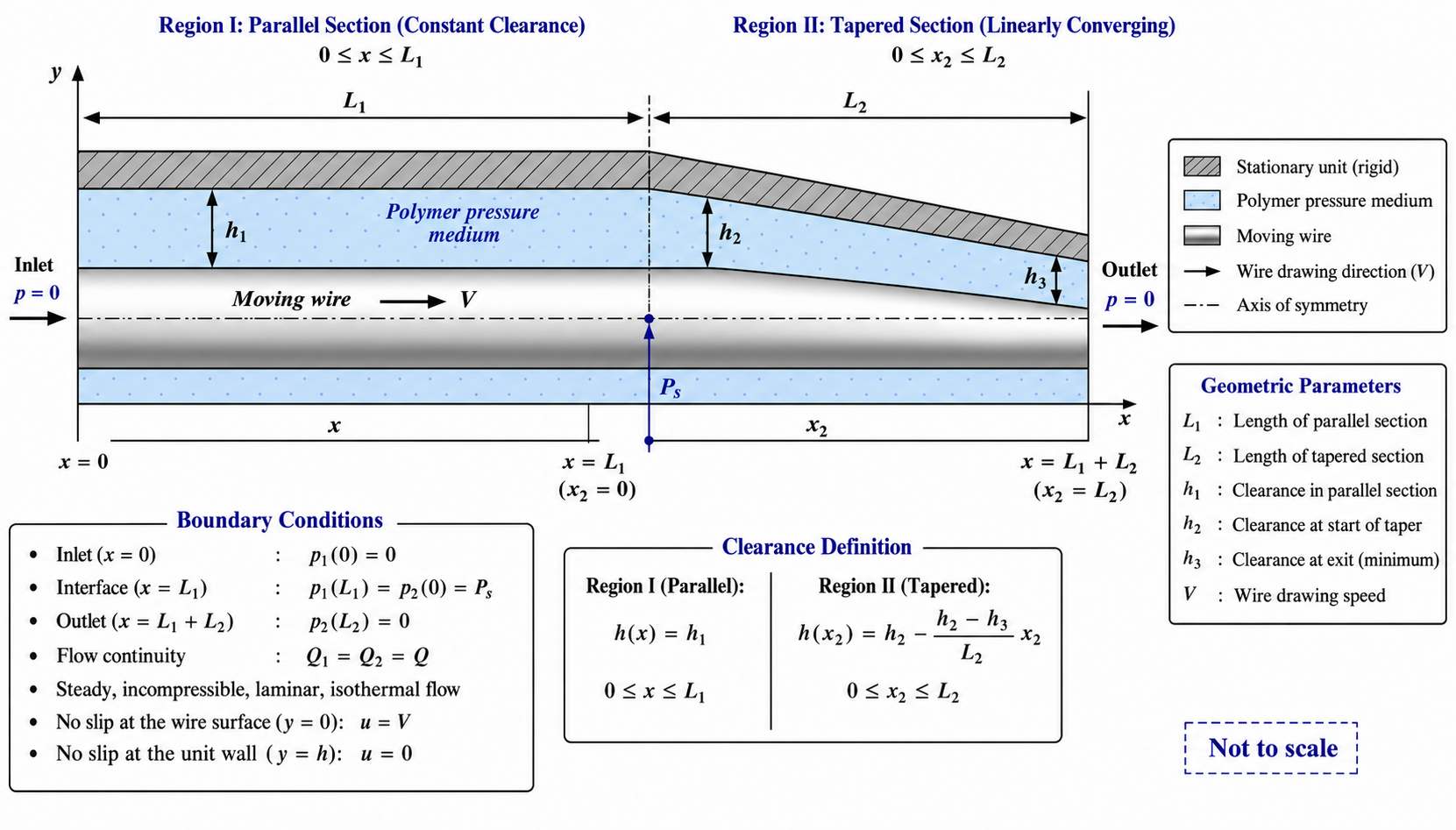
Hydrodynamic pressure generation in a combined stepped-tapered pressure unit was analysed using a deterministic closed form Newtonian lubrication model implemented in Microsoft Excel. A constant-clearance section and a linear taper were coupled through common flow and pressure continuity conditions, yielding explicit expressions for the flow rate, interface pressure, piecewise pressure field, maximum pressure, and peak location. The contribution is a compact analytical benchmark rather than a new geometry or governing theory; it separates the dimensional pressure scale μV from the geometric response governed by λ, r₁, and r₂. An independent midpoint finite-difference implementation with grid refinement produced baseline differences below 0.001%, verifying mathematical consistency but not physical validation. For the baseline geometry, Pₘₐₓ [MPa] = 1.217135S, where S = μV in Pa·m. Increasing r₂ from 10 to 18 reduced the dimensionless maximum pressure by 31.1% and shifted the peak slightly downstream. A deterministic ±5% perturbation of the outlet clearance h₃ changed Pₘₐₓ increased by 5.24% and decreased by 4.74%, respectively, while xₘₐₓ changed by less than 0.14%. For the prescribed 2 mm solid wire, h₁/Rw = 1.00, h₂/Rw = 0.50, and h₃/Rw = 0.05 show that the planar approximation is not uniformly valid. The model is therefore an analytical and computational benchmark, not a geometry exact industrial design model.
Published
How to Cite
Issue
Section
Copyright (c) 2026 Int. J. Electr. Eng. Sustain.

This work is licensed under a Creative Commons Attribution-NoDerivatives 4.0 International License.