Evaluating the Impact of Seasonal Environmental Variations on Hybrid SAR/LiDAR FOPEN System Performance
Keywords:
FOPEN, Ka-band SAR, LiDAR, Sensor fusion, Micro-Doppler, Seasonal analysis, Diurnal variations, Vegetation water contentAbstract
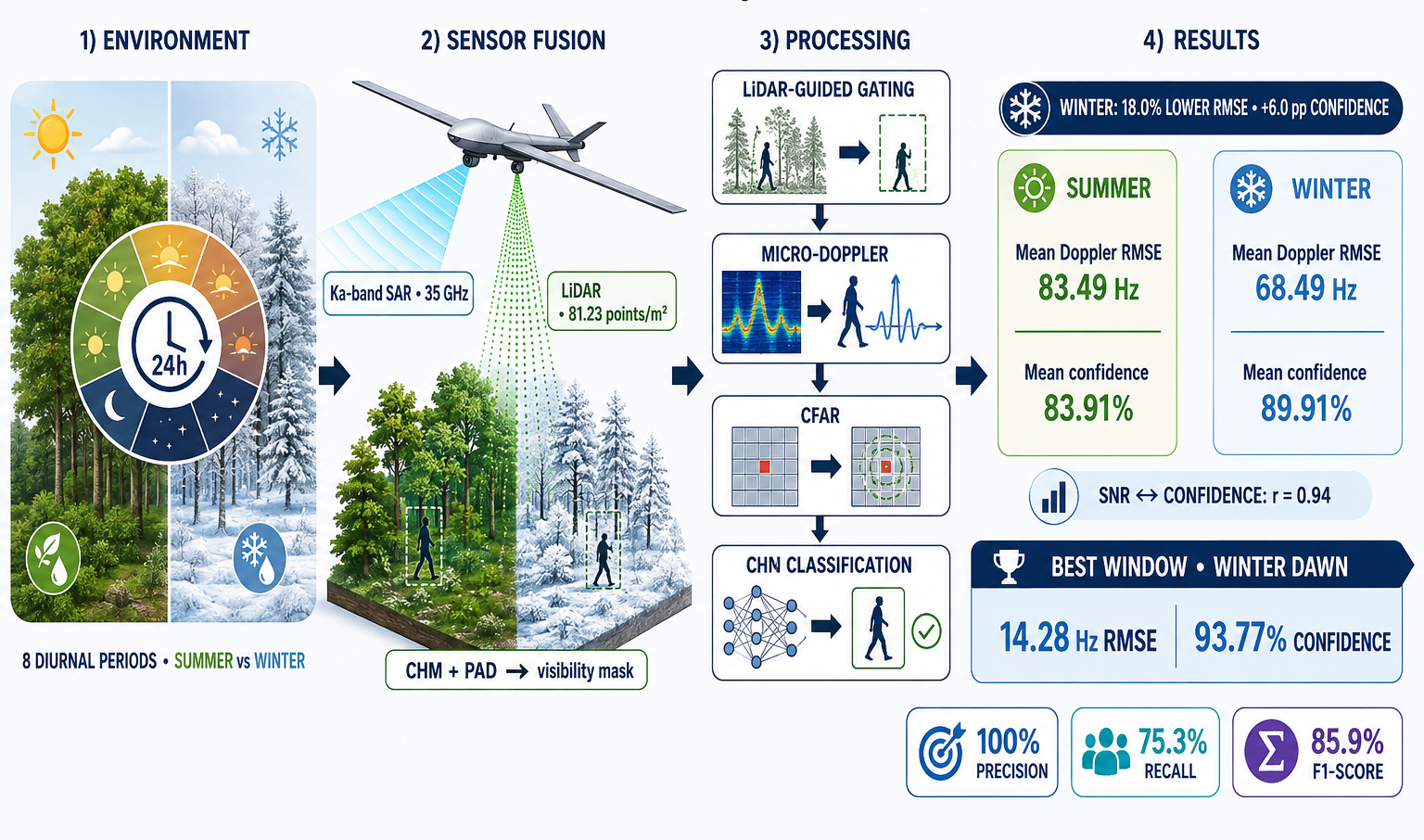
This paper provides a detailed analysis of a hybrid Ka-band SAR/LiDAR Foliage Penetration (FOPEN) system for the detection of humans in terms of their diurnal and seasonal variations. The performance assessment considers eight unique time periods within both summer and winter seasons. By incorporating 35 GHz Ka-band SAR and employing LiDAR gating (81.23 points/m²) in real time, the hybrid approach makes use of the CHM and PAD profiles provided by LiDAR to develop the visibility mask, thereby reducing foliage clutter. Through simulations using MATLAB, it is revealed that winter results in a better performance through a 18.0% improvement in the mean Doppler RMSE (68.49 Hz versus 83.49 Hz) as well as a 6.0% higher mean confidence (89.91% versus 83.91%). The optimal time to operate the system is found to be dawn, especially during the winter season (Doppler RMSE: 14.28 Hz, Confidence: 93.77%). There exists a positive correlation between SNR and confidence (r=0.94), thus proving the validity of the multi-factor confidence model. The hybrid system proves its strong ability of classification through 100% precision and 75.3% recall of human targets.
Published
How to Cite
Issue
Section
Copyright (c) 2026 Int. J. Electr. Eng. Sustain.

This work is licensed under a Creative Commons Attribution-NoDerivatives 4.0 International License.