An sEMG-Controlled 3D-Printed Prosthetic Hand Using a Compact 1D-CNN Pipeline: Prototype Integration and Preliminary Bench Evaluation
Keywords:
Surface electromyography, prosthetic hand, 3D printing, convolutional neural network, embedded rehabilitation roboticsAbstract
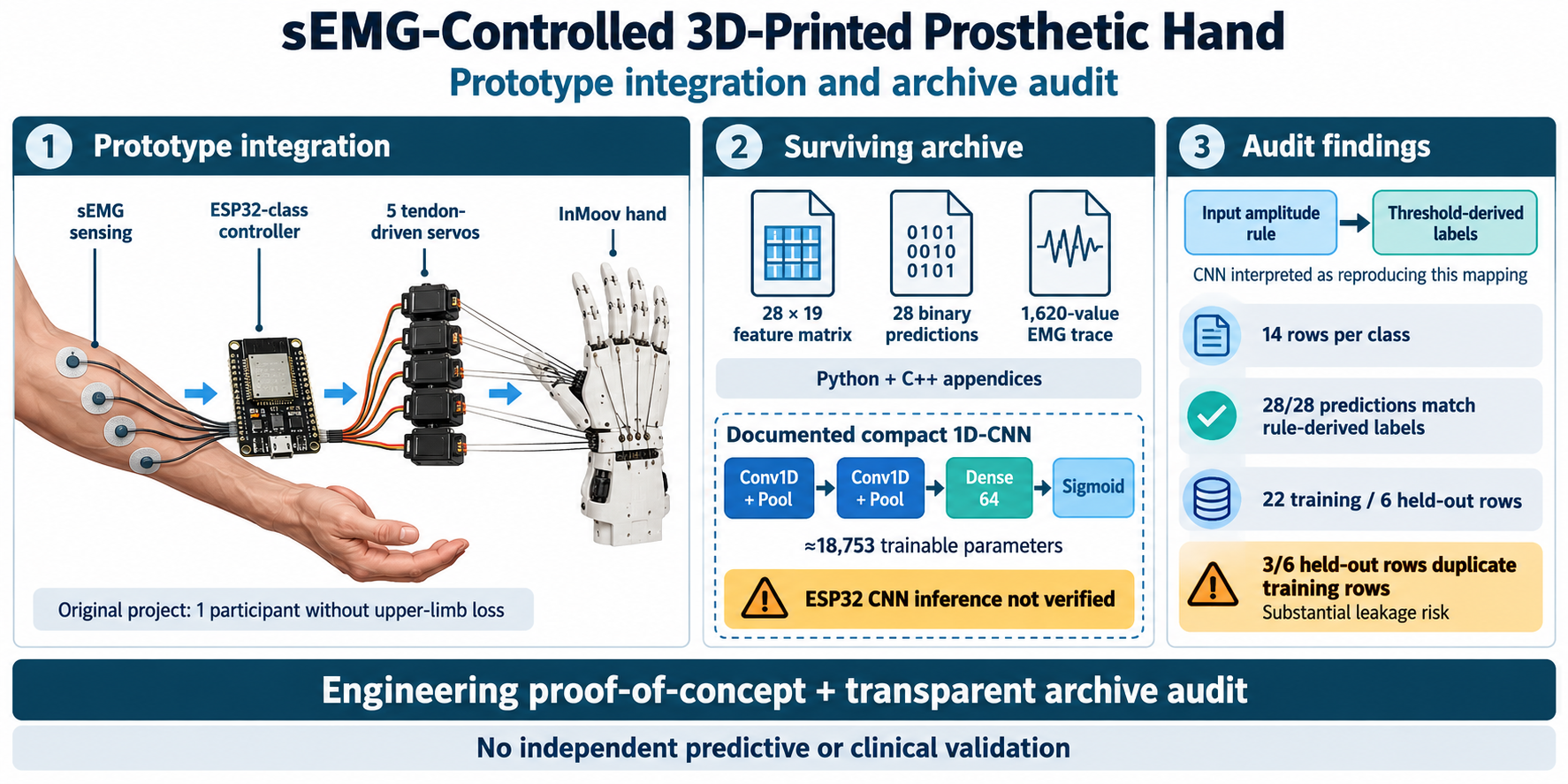
Myoelectric prosthesis research requires control chains that are reproducible on constrained hardware and transparent about evidential limits. This work presents a 3D-printed upper-limb prototype combining surface electromyography (sEMG) sensing, an InMoov hand, five tendon-driven servo actuators, an ESP32-class controller, and an archived compact one-dimensional convolutional neural network (1D-CNN) pipeline. The original student project involved one participant without upper-limb loss. For the present revision, the surviving archive was audited rather than reconstructed by imputation: a 28 x 19 feature matrix, a 28-entry binary prediction file, and a 1,620-value single-channel EMG trace were inspected together with the preserved Python and C++ appendices. The training code generated target labels from an amplitude rule applied to the same input values, so the CNN is interpreted as reproducing a threshold-derived mapping rather than as independently validated physiological intent recognition. Applying the archived training rule to the surviving feature matrix yields 14 rows per class, and the preserved predictions agree with those threshold-derived labels for all 28 rows. Replaying the documented 80/20 random split produces 22 training and 6 held-out rows; exact duplicate rows from the training set are present in 3 of the 6 held-out rows, confirming substantial leakage risk. The CNN architecture remains identifiable as two Conv1D/max-pooling stages followed by a 64-unit dense layer and sigmoid output (approximately 18,753 trainable parameters), but full CNN inference on the ESP32 cannot be verified from the surviving firmware. The contribution is therefore a transparent engineering proof-of-concept and archive audit that preserves the 1D-CNN as a documented component while separating pipeline reconstruction from claims of independent predictive or clinical performance.
Published
How to Cite
Issue
Section
Copyright (c) 2026 International Journal of Electrical Engineering and Sustainability

This work is licensed under a Creative Commons Attribution-NoDerivatives 4.0 International License.