Improving Dermoscopic Melanoma Recall via a Weighted Xception–EfficientNetB4 Ensemble and Test-Time Augmentation
Keywords:
Melanoma detection, dermoscopy, deep learning, transfer learning, ensemble learningAbstract
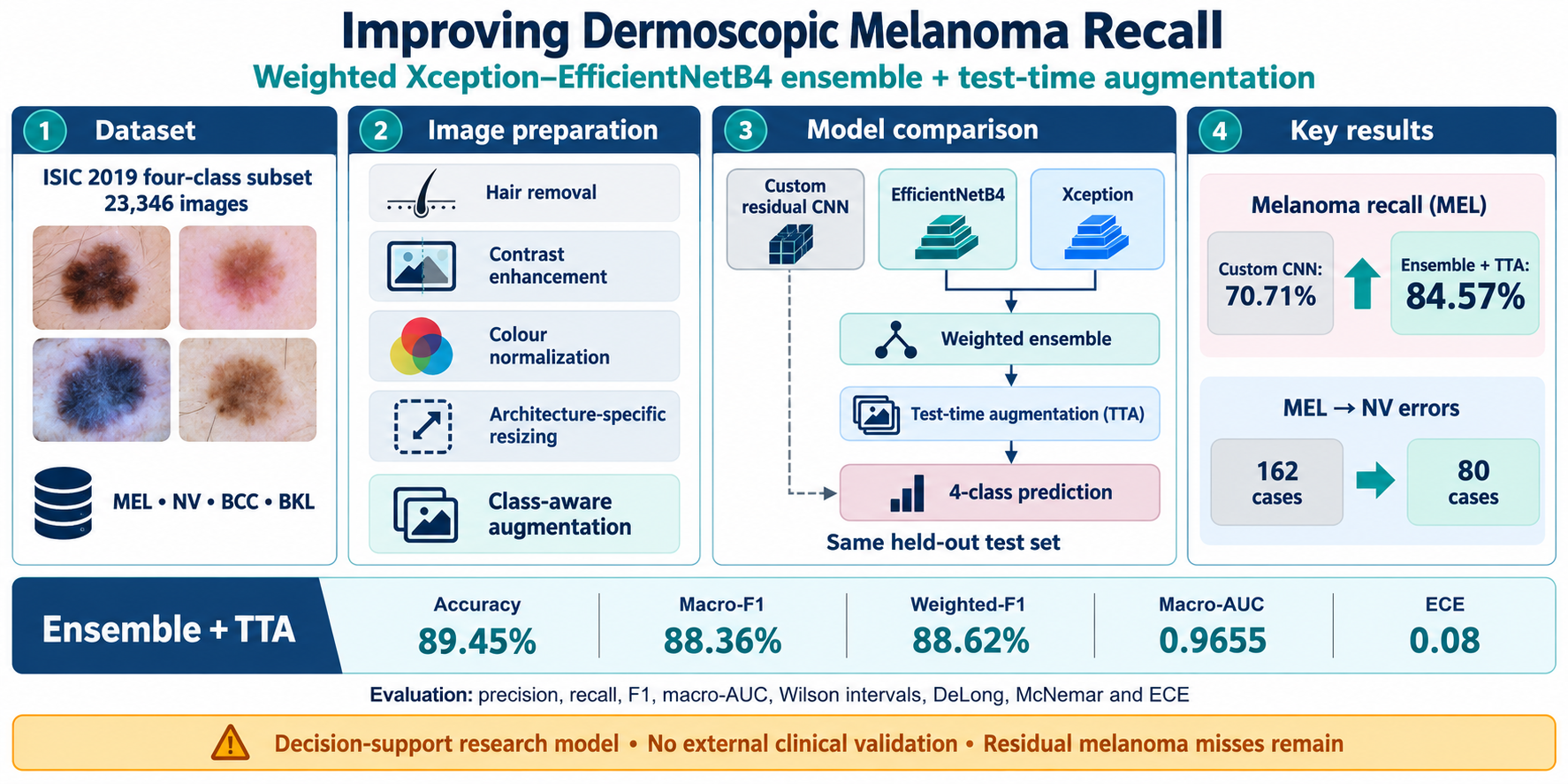
Automated dermoscopic image classification can support skin-lesion assessment, but severe class imbalance in public datasets can conceal poor melanoma sensitivity behind high overall accuracy. This study investigated whether combining complementary transfer-learning architectures with class-aware augmentation and test-time augmentation (TTA) could improve melanoma detection.A four-class subset of the ISIC 2019 archive containing 23,346 images of melanoma (MEL), melanocytic nevus (NV), basal cell carcinoma (BCC), and benign keratosis (BKL) was evaluated. Images underwent automated hair removal, contrast enhancement, colour normalization, and architecture-specific resizing. A custom residual CNN, EfficientNetB4, Xception, and a weighted Xception–EfficientNetB4 ensemble were compared on the same held-out test set. Performance was assessed using accuracy, precision, recall, F1-score, macro-AUC, Wilson confidence intervals, DeLong's test, McNemar's test, and expected calibration error (ECE). The ensemble with TTA achieved 89.45% accuracy, 88.36% macro-F1, 88.62% weighted-F1, and 0.9655 macro-AUC. Melanoma recall increased from 70.71% with the custom CNN to 84.57% with the final ensemble. Melanoma misclassification as nevus decreased from 162 to 80 cases. The ensemble also had the lowest reported ECE (0.08). Weighted ensembling with TTA improved classification performance and melanoma sensitivity under the evaluated conditions. The residual melanoma miss rate and absence of external clinical validation indicate that the system should be considered a decision-support research model rather than an autonomous diagnostic system.
Published
How to Cite
Issue
Section
Copyright (c) 2026 International Journal of Electrical Engineering and Sustainability

This work is licensed under a Creative Commons Attribution-NoDerivatives 4.0 International License.