Impact of Dust, Sandstorms, and Air Pollution on Solar Energy Conversion Efficiency
Keywords:
Dust deposition, Sandstorms, Air pollution, Solar energy conversion efficiencyAbstract
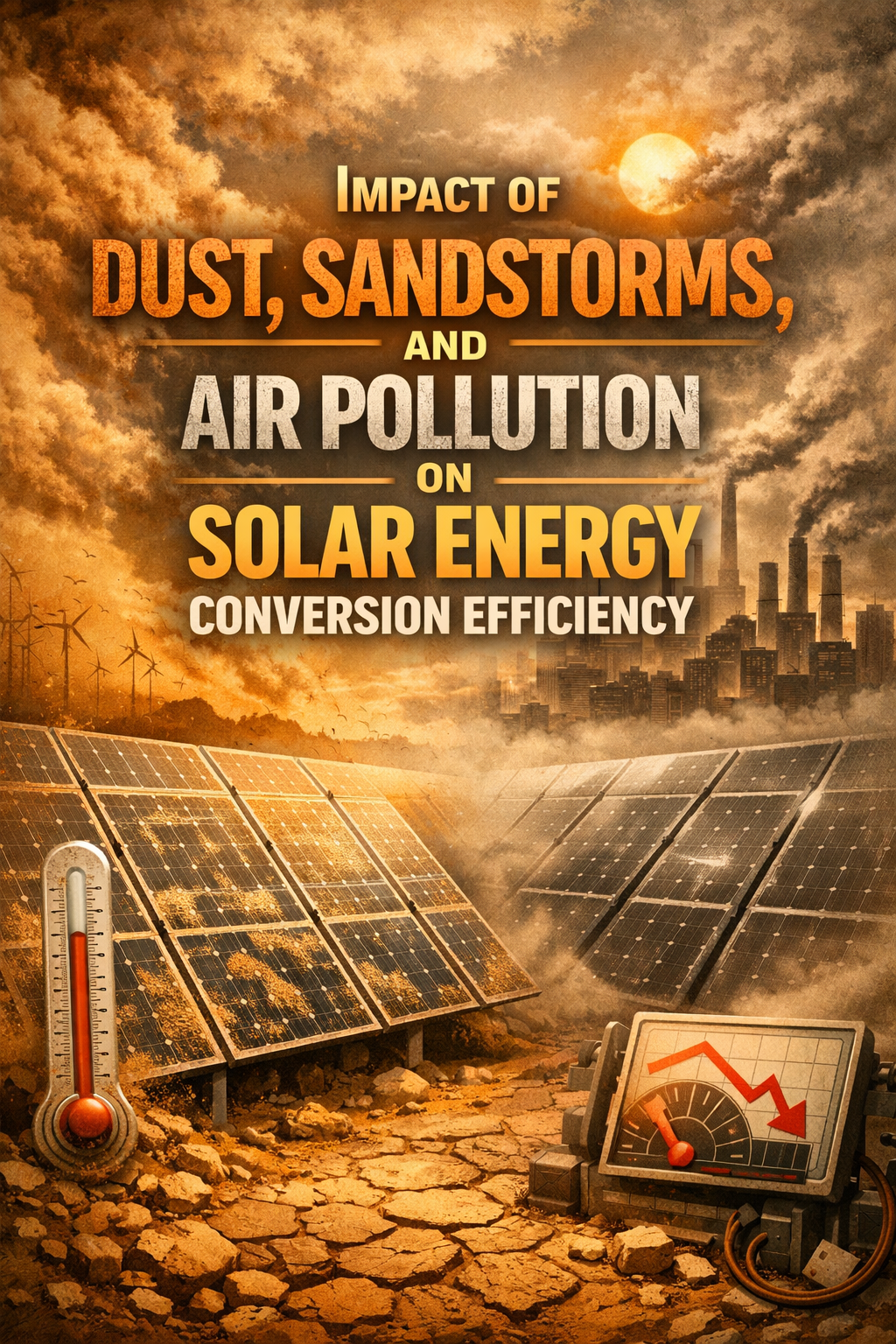
This article examines the impact of dust deposition, sandstorms, and air pollution on solar energy conversion efficiency, with particular focus on photovoltaic and solar thermal systems operating in harsh environments. The analysis shows that dust accumulation on solar panel surfaces reduces optical transmittance, lowers power output, and decreases overall conversion efficiency, with the severity of losses depending on particle density, size, composition, humidity, tilt angle, and exposure duration. Sandstorms were found to cause both immediate and long-term performance degradation through atmospheric reduction of solar irradiance, post-storm soiling, and mechanical abrasion of exposed surfaces. In addition, air pollution, including particulate matter, aerosols, and industrial emissions, attenuates solar radiation through scattering and absorption processes, thereby reducing the amount of usable solar energy reaching solar conversion devices and increasing uncertainty in energy yield prediction. The study further highlights that mitigation strategies such as regular cleaning, anti-soiling coatings, optimized tilt angles, real-time monitoring, and predictive maintenance are essential for limiting performance losses and improving system reliability. Overall, the findings confirm that environmental degradation mechanisms must be systematically integrated into solar energy planning, design, and operation to enhance energy yield, reduce maintenance costs, and ensure the long-term technical and economic viability of solar systems in dusty and polluted regions.
Published
How to Cite
Issue
Section
Copyright (c) 2025 Int. J. Electr. Eng. Sustain.

This work is licensed under a Creative Commons Attribution-NoDerivatives 4.0 International License.