Emerging Trends in Solar PV Performance Enhancement: Cooling, Concentration, Spectral Splitting, and Tracking Techniques
Keywords:
Solar Radiation, Ambient Temperature, Atmospheric Conditions, Extreme Weather Events, PV System PerformanceAbstract
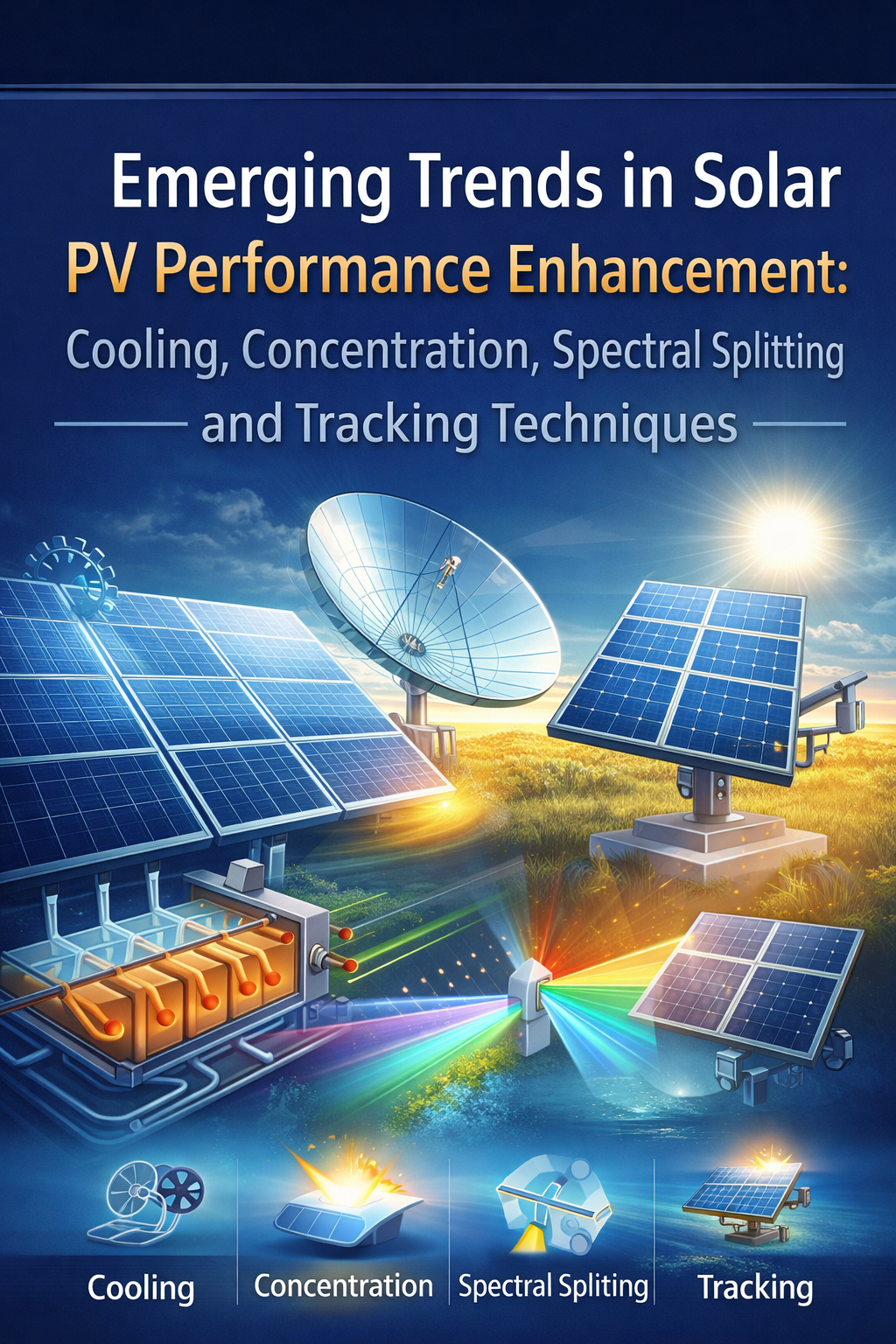
The worldwide need for clean sustainable energy has boosted research on solar photovoltaic (PV) systems to enhance their productivity, dependability, and flexibility. Despite major breakthroughs in materials and manufacturing, PV modules suffer significant performance drops under real-world conditions due to higher cell temperatures uneven sunlight, and off-center sun angles. This article gives updates on new trends and technologies that aim to boost PV performance focusing on four key areas: cooling methods concentrated photovoltaic (CPV) systems solar trackers, and their benefits and drawbacks. The first part of the article looks at the development of both passive and active cooling techniques. These include air and liquid cooling methods, phase change materials (PCM), and hybrid PV/T cooling systems. These approaches help reduce temperature-related degradation and increase energy output. The second part explores CPV technologies that use optical concentration such as Fresnel lenses parabolic reflectors, and cold mirrors. These technologies can deliver more sunlight through a smaller PV surface area and/or with less heat on the PV module. The third section looks into how tracking technologies have evolved from single-axis to more complex dual-axis systems, and their impact on boosting solar exposure while cutting down on shade-related losses. The article explores the main possibilities and hurdles linked to bringing in these technologies focusing on what's technically and doable as well as eco-friendly answers. To wrap up, the paper shows that innovations in solar cooling, concentration, and tracking made possible by cutting-edge control algorithms and modular designs offer a promising way to push forward PV systems that can handle climate changes and deliver top-notch performance.
Published
How to Cite
Issue
Section
Copyright (c) 2026 Int. J. Electr. Eng. Sustain.

This work is licensed under a Creative Commons Attribution-NoDerivatives 4.0 International License.